

Request a Quote Today

Thank You For Your Interest in E-Control Systems Please fill out the required fields here. We will review your request and contact you back shortly. If you have any questions about this quote, or our service in general, please feel free to contact us here or call us at 818.783.5229.

    (By providing my contact information below, I consent that E-Control Systems can contact me with information regarding my quote.)

    Image Alt
    E-Control Systems
     . Blog  . How to Monitor Food Temperatures in a Restaurant: Manual Logs vs. Chart Recorders vs. Wireless Systems

    How to Monitor Food Temperatures in a Restaurant: Manual Logs vs. Chart Recorders vs. Wireless Systems

    There are three main ways that restaurants monitor food and equipment temperatures. Staff can check temperatures by hand and record them in a logbook, chart recorders can be mounted on each unit, or wireless sensors can log everything automatically. All three methods can pass a health inspection, but they are very different when it comes to labor, reliability, and what happens when a cooler fails after closing time. Here is how each method works and how to choose the right one for your kitchen.

    Method 1: Manual Thermometers and Paper Logs

    With manual monitoring, a staff member probes food and reads equipment thermometers on a set schedule, then writes each reading on a log sheet. This is the cheapest method to start with, since a calibrated probe thermometer costs under $50. It is also still the right tool for point-in-time checks like receiving deliveries and verifying end-of-cooking temperatures, because those checks require the internal temperature of the food itself. The weakness of manual monitoring is everything that happens between checks. A reading tells you a unit was safe at 7:00 a.m. and tells you nothing about 7:15. Manual monitoring works best in operations with only a few refrigeration units, consistent staffing, and a manager who reviews the logbook regularly. Even then, it should be treated as a spot check rather than a safety net.

    Method 2: Chart Recorders

    A chart recorder traces temperature continuously onto a rotating paper disc mounted on the unit, so you get a true 24/7 record. For decades this was the standard way to document walk-in cooler and freezer temperatures, and filed discs still satisfy documentation requirements in most areas. Chart recorders do have some real drawbacks. Discs and pens need to be replaced on a regular basis, charts have to be swapped out on schedule and stored for years, and the recorder cannot alert anyone when something goes wrong. Someone has to physically look at the disc to discover that the walk-in spent six hours out of range, and by then the food decision has usually already been made for you.

    Method 3: Wireless Temperature Monitoring

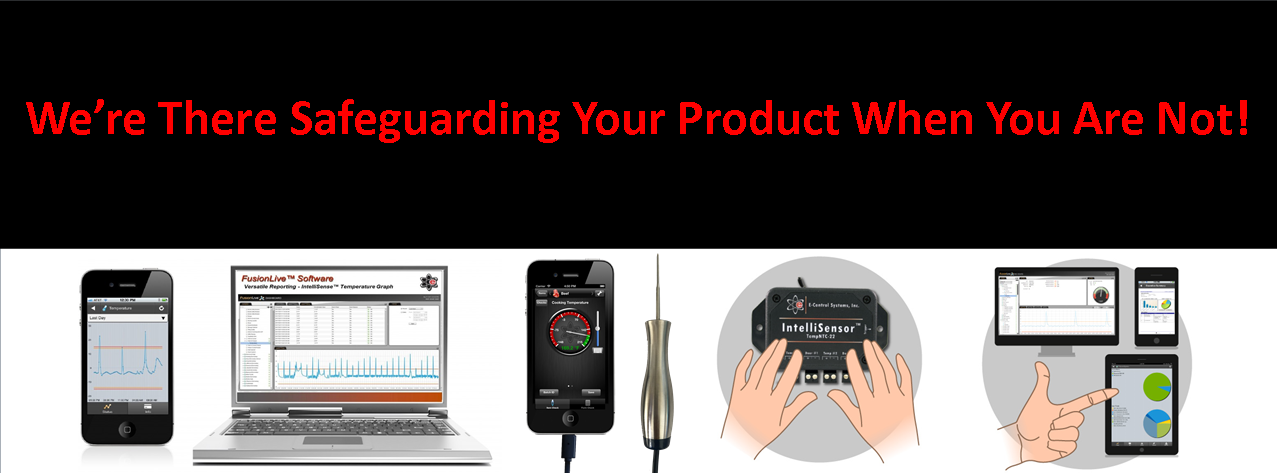
    With wireless monitoring, battery-powered sensors sit inside each cooler, freezer, and holding unit, take readings around the clock, and send them to a cloud dashboard that you can open from your phone. This method covers the two things the older methods cannot do. It alerts you the moment a unit drifts out of range, and it produces time-stamped digital records whenever you need them. Handheld probe attachments extend the same automatic logging to line checks and receiving, so your food-level and equipment-level records live in one place. To see what a complete setup looks like in a working kitchen, including sensors, gateways, the dashboard, alerts, and HACCP reporting, visit our food service temperature monitoring system page.

    Manual Logs vs. Chart Recorders vs. Wireless Monitoring: Side-by-Side

    Factor Manual Logs Chart Recorders Wireless Monitoring
    Records between checks No Yes (paper trace) Yes (digital, searchable)
    Alerts you to a failure Only if someone is checking No Yes, instantly by phone
    Recurring costs Staff time every shift Discs, pens, filing labor Minimal after installation
    Measures internal food temp Yes (probe) No (air temp only) Yes, with handheld probes
    Inspection documentation Handwritten logbook Filed paper discs Time-stamped digital export
    Best fit Spot checks at receiving and on the cook line Legacy single-unit documentation Whole-kitchen coverage and multi-unit operations

    Which Food Temperature Monitoring Method Does Your Restaurant Need?

    Most kitchens end up using more than one method, so the question is really about what each method is responsible for. Probe thermometers stay on the line for food-level checks no matter what else you run, because the internal temperature of the food and the air temperature of the cabinet are two different measurements. The bigger decision is how you cover your equipment. A single-location operation with two or three units and a hands-on owner can run disciplined manual checks. A kitchen with a full set of walk-ins, reach-ins, and high-volume ovens, or any operation where no one is on site overnight, needs continuous coverage that can raise an alarm. If your HACCP plan lists holding or storage temperatures as critical control points, automated logging also takes care of the record-keeping, which is the weakest link in most plans. If aging equipment is the root cause of your temperature problems, it makes sense to address that first. Our guide to choosing commercial refrigeration can help.

    How Often Should Food Temperatures Be Checked?

    For held TCS food, temperatures should be checked at least every four hours, because food found in the danger zone at the four-hour mark must be thrown out. Many operators check every two hours instead, which leaves time to correct a problem and save the product. You should also probe food at receiving, at the end of cooking, and during cooling, when time limits are strictest. Not every food requires this level of attention, and our TCS foods guide covers which ones do. For the specific temperature targets by food type, see our safe food temperatures chart. Equipment runs on a different schedule. If you monitor manually, refrigeration should be verified at open and close at a minimum, and continuous monitoring exists to close the gap in between.

    Frequently Asked Questions

    Are chart recorders still accepted for health inspections?

    Generally yes. A filed, legible chart disc is a valid temperature record in most jurisdictions. Keep in mind that discs document problems without preventing them, and storing years of paper charts becomes a burden of its own.

    Can you mix monitoring methods?

    Most kitchens should. Probe thermometers handle food-level checks while continuous monitoring guards the equipment and generates the compliance record. Together they cover the full operation.
    What is the biggest mistake restaurants make with temperature logs?

    Filling them out from memory. Recording readings after the fact, or copying yesterday’s numbers, leaves your business exposed. Inspectors recognize suspiciously uniform logs, and a log that does not reflect reality can hurt you more than a gap in the record.


    For more information about what E-Control Systems can do for your food service business, take a look at our Food Service solutions.